Why You're Constipated — and 9 Fixes That Actually Work
It is one of the most common health complaints in America, and almost nobody talks about it. About 16 out of every 100 U.S. adults have constipation symptoms, and among adults 60 and older, that number climbs to roughly 1 in 3, according to the National Institute of Diabetes and Digestive and Kidney Diseases (NIDDK).
The irony? Constipation is one of the few health problems where simple lifestyle fixes genuinely outperform the medicine cabinet in most cases. Here is what is really slowing things down — and the nine fixes with the most evidence behind them.
First, what "constipated" actually means
Doctors define it loosely: fewer than three bowel movements a week, stools that are hard, dry, or lumpy, or the feeling that you haven't fully emptied. But normal varies — anywhere from three times a day to three times a week can be perfectly healthy.
Constipation is essentially a plumbing-and-timing problem. Your colon absorbs water from waste as it moves through; the slower the trip, the more water gets pulled out, and the harder the stool becomes. Almost every fix on this list works by speeding the trip up, softening the cargo, or both.
1. Drink more water — especially if you add fiber
Dehydration is one of the most underrated causes of hard stools. Your colon is relentless: given the chance, it will wring nearly every drop of moisture out of waste. If you are running dry overall, your stool dries out first.
The fix is embarrassingly simple: drink enough that your urine stays pale yellow — about 11.5 cups of total fluids a day for women and 15.5 for men, per the National Academies. And if you are boosting fiber without boosting water, you can actually make things worse — fiber without fluid bulks up like cement.
2. Eat prunes — the most studied natural fix
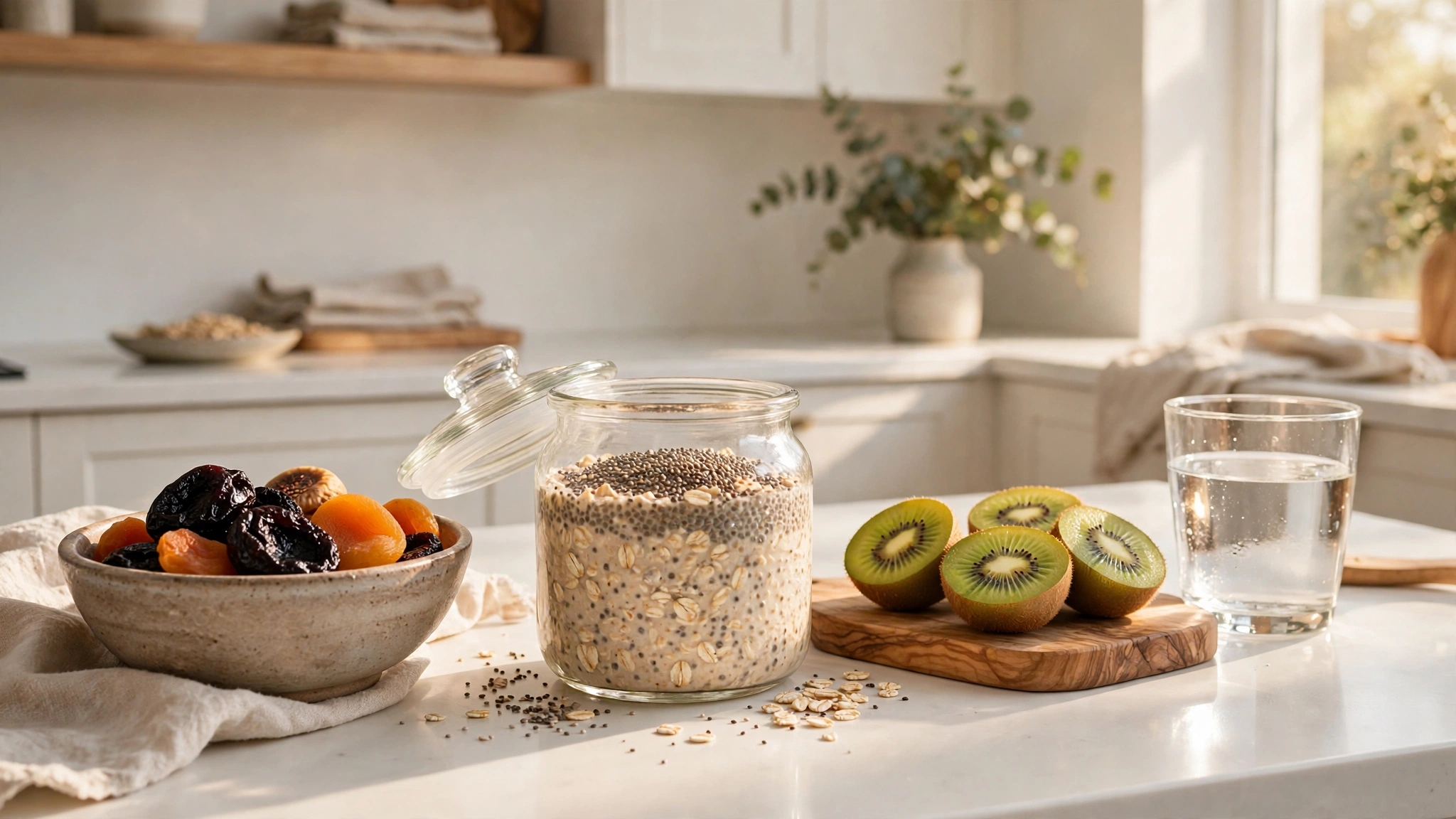
If one food deserves a spot at the top, it is prunes. A randomized trial out of Baylor College of Medicine found that prunes beat psyllium husk — the fiber in most bulk laxatives — at improving stool frequency and consistency. The reason is a triple punch: fiber, sorbitol (a natural compound that pulls water into the bowel), and plant compounds that gently stimulate the gut.
The studied dose is about 50 grams a day — roughly 5 to 6 prunes. If you don't love prunes, try kiwis: trials have found that eating two kiwis a day significantly improved stool frequency.
3. Close the fiber gap — slowly
Americans average only about 16 grams of fiber a day, far below the Dietary Guidelines target of 28 to 34 grams. That gap is one of the biggest drivers of sluggish bowels, because fiber is what gives stool its bulk and helps it move.
But the ramp-up matters more than the target. Jumping from 15 grams to 35 grams overnight is a recipe for gas, bloating, and regret. Add roughly 5 grams a week — a cup of oatmeal (about 4 grams), a half-cup of black beans (about 7.5 grams), or a tablespoon of chia seeds (about 5 grams) in yogurt — and increase water in step with the fiber.
4. Move your body — even a short walk helps
Your colon loves motion. Physical activity stimulates the intestinal muscles, and you don't need a marathon — a 10- to 20-minute walk, especially after meals, when the gastrocolic reflex is already nudging your gut, can be enough to get things moving.
Desk workers are especially vulnerable: long hours sitting means long hours of an idle gut. If mornings are your problem, a short walk around the block after breakfast is one of the cheapest constipation fixes there is.
5. Use a footstool — fix your posture
Your body wasn't designed for a modern toilet. When you sit at a 90-degree angle, a muscle called the puborectalis stays partially kinked, like a kink in a garden hose. Lifting your knees above your hips — a footstool, a stack of books, anything 7 to 9 inches tall — straightens the anorectal angle and lets things pass with less effort.
A 2015 study in the Journal of Clinical Gastroenterology found that the footstool posture produced faster, more complete, and less-strained bowel movements across the board. It is a $25 fix that gastroenterologists recommend constantly.
6. Don't ignore the urge — and time it right
Your gut is most eager to go first thing in the morning and after meals, thanks to the gastrocolic reflex — a wave of colon contractions triggered by eating. That is why coffee sends so many people running: coffee stimulates colonic activity in roughly 30 percent of drinkers, starting within minutes.
If you consistently suppress the urge — rushing out the door, holding it through meetings — the urge fades, stool sits longer, dries out more, and the cycle deepens. Treat the morning bathroom window as an appointment, and breathe instead of straining: chronic straining can cause hemorrhoids and, over years, weaken the pelvic floor.
7. Consider magnesium — the mineral your gut wants
Magnesium draws water into the intestines, which softens stool — it is the active mechanism in "milk of magnesia," one of the oldest remedies still in drugstores. A glass of water with 200 to 400 mg of magnesium citrate at bedtime works for many people as a gentle overnight fix. One caution: if you have kidney disease, talk to your doctor before supplementing, since impaired kidneys can't clear excess magnesium properly.
8. Check your medicine cabinet
A surprising number of everyday medications slow the gut: opioid painkillers, iron supplements, antihistamines like diphenhydramine (Benadryl), blood pressure drugs including calcium-channel blockers, antidepressants, and aluminum- or calcium-based antacids. If your constipation started soon after a new prescription, that's a strong suspect.
Never stop a prescription on your own — but do bring it up with your doctor or pharmacist. There is often an alternative drug, a dose tweak, or a counteracting strategy.
9. Try fermented foods — feed the right bacteria
Your gut bacteria play a real role in transit time, and fermented foods deliver live cultures that help keep things moving. A daily serving of yogurt with live active cultures, kefir, kimchi, or sauerkraut has modest but real evidence behind it for easing mild constipation — particularly when paired with adequate fiber.
When it's more than a lifestyle problem
Most constipation is diet, hydration, and habits. But see a doctor if you notice:
- Blood in your stool or black, tarry stools
- Stools that have become persistently narrow or pencil-thin
- Unexplained weight loss of 10 pounds or more
- Constipation that is new, severe, or hasn't improved after three weeks of these fixes
- A family history of colon cancer or inflammatory bowel disease
These can signal something that needs evaluation — hemorrhoids, thyroid problems, or, rarely, colorectal cancer, which is rising in Americans under 50.
The bottom line
Constipation is miserable, common, and — for most people — fixable without a pharmacy run. Start where the evidence is strongest: water, fiber ramped up slowly, prunes, movement, and a footstool. Give any change a full week or two before judging it. Your gut responds to consistency, not one heroic salad.
Medical disclaimer: This article is for informational purposes only and is not a substitute for professional medical advice, diagnosis, or treatment. Always seek the advice of your physician or another qualified health provider with any questions you may have regarding a medical condition.
📚 Keep reading:

That Q-Tip in Your Ear Is Doing More Harm Than Good
About 34 kids a day land in the ER from cotton-swab ear injuries. Ear doctors say the ear canal cleans itself — here's the safe way to deal with earwax.

Appendicitis: 7 Warning Signs Your Belly Pain Is Serious
Lower-right belly pain, fever, nausea, no appetite? Appendicitis moves fast — and a burst appendix can turn deadly. Here's how ER doctors tell it apart from gas or a stomach bug.
Heart Palpitations: When Skipped Beats Are Dangerous
Your heart skips, flutters, or pounds out of nowhere — and your mind goes straight to heart attack. Most palpitations are harmless, but some are a warning. Here's how to tell.