Why Your Fingernails Have Ridges — and When to Worry
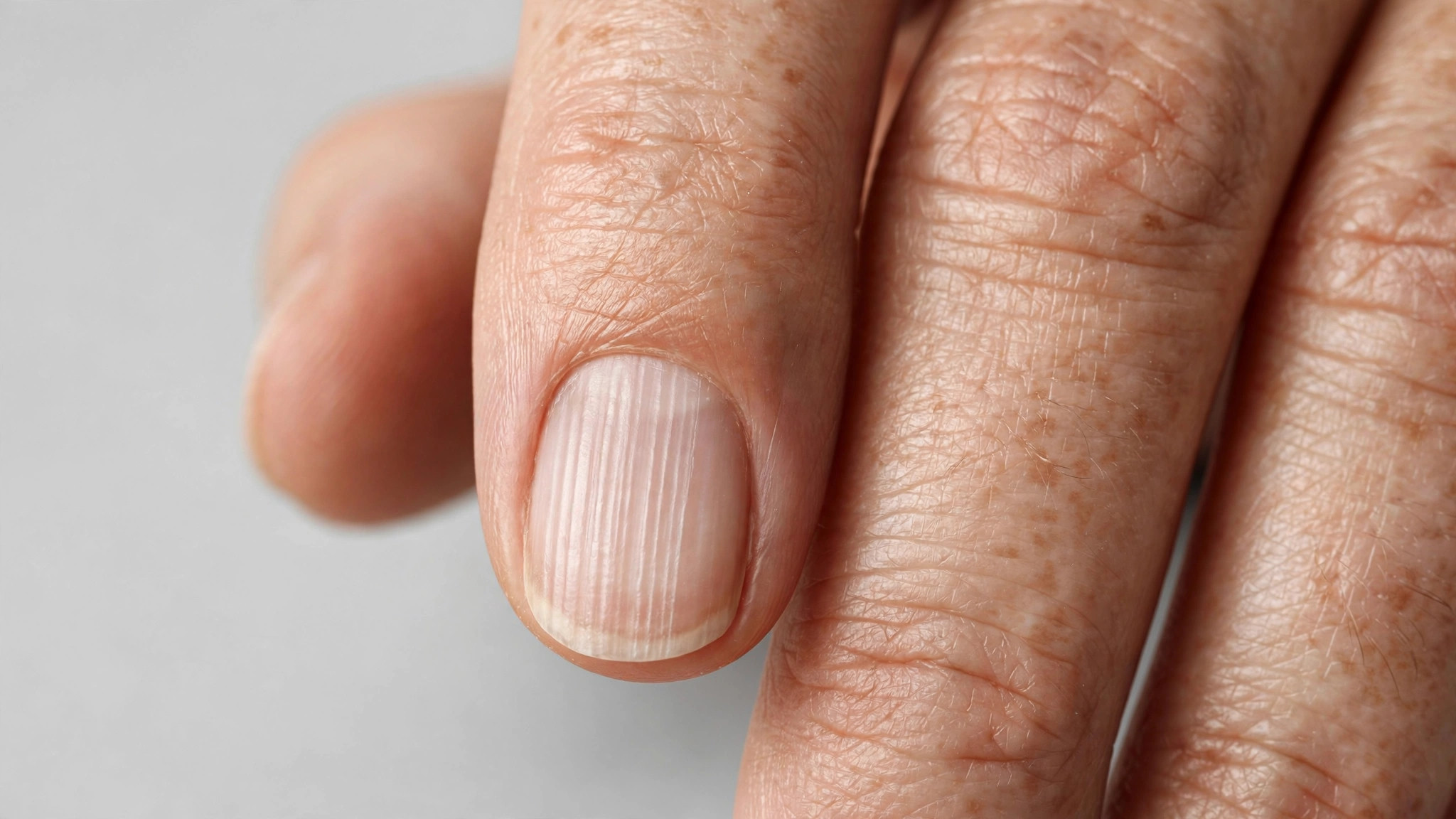
Take a close look at your fingernails in good light. If you can feel or see fine lines running from the cuticle to the tip, you are looking at one of the most common nail changes dermatologists see — and in the vast majority of cases, they are completely harmless.
Still, nails are a genuine window into your health. Certain patterns of ridges, grooves, and color changes can signal everything from a nutrient deficiency to a heart or liver condition. Here is how to tell the difference between normal aging and something worth showing your doctor.
Vertical ridges: almost always just age
Those thin vertical lines running the length of your nails — what doctors call longitudinal striations or onychorrhexis — are the most common ridge pattern by far. They develop because the cells that build your nail (the nail matrix, hidden under the cuticle) produce nail a little less evenly as you age.
Think of it like skin wrinkles: by the time most Americans hit their 40s and 50s, some vertical ridging is nearly universal. The nails can also grow thinner, split more easily at the edges, and look slightly duller. None of this reflects a vitamin deficiency, despite what social media claims. It reflects time.
When to pay attention: vertical ridges accompanied by deep splitting, peeling at the nail edges, or ridges that are unusually rough and deep on every nail can point to dehydration, thyroid changes, or, less commonly, anemia or psoriasis. But ridges alone — smooth, fine, symmetrical across the nails — are a cosmetic change, not a diagnosis.
Horizontal grooves (Beau's lines): the illness timeline
Far more interesting to doctors are Beau's lines — horizontal dents or grooves running across the nail, often deep enough to catch a fingernail. Unlike vertical ridges, these are not a slow-aging change. They form when a significant illness, infection, or injury temporarily shuts down nail growth, and the nail carries the dent outward like a tree ring recording a bad winter.
Fingernails grow about 1/8 of an inch (3.5 mm) per month, according to the American Academy of Dermatology, so a Beau's line halfway down the nail roughly marks an event three months ago — a bad flu, a bout of pneumonia, uncontrolled diabetes, a severe zinc deficiency, or even chemotherapy. If the groove appears on one nail only, it was likely local trauma (a slammed door, an infection around the cuticle). If it marches across all ten nails at the same height, the cause was systemic.
Beau's lines usually grow out on their own in 3 to 6 months once the underlying problem resolves. Repeated grooves on every nail, however, deserve a medical visit — they suggest an ongoing, untreated issue.
What else your nails might be telling you
Ridges are only one chapter of the nail story. Dermatologists read the whole page:
- White spots (leukonychia). The most Googled nail concern in America, and the myth is that they signal calcium deficiency. In reality, they are almost always tiny injuries to the nail bed — a bump against a countertop or rough manicure. They grow out and vanish.
- Spoon nails (koilonychia). Nails that curve upward at the edges like a spoon can be an early sign of iron-deficiency anemia. The CDC estimates that roughly 1 in 10 U.S. women ages 12 to 49 are iron deficient, so this one is worth knowing — especially if it comes with fatigue or restless legs.
- Yellow, thickened nails. Often fungal infection (onychomycosis), which becomes more common with age and in people with athlete's foot. But persistent yellowing can also appear with psoriasis or, rarely, thyroid or lymphatic conditions.
- Pitting. Tiny dents like the surface of a thimble are a classic sign of psoriasis and can appear years before skin patches.
- Clubbing. Fingertips that widen and nails that curve dramatically downward can indicate low blood oxygen — linked to lung disease, heart disease, or inflammatory bowel disease. This is the nail change doctors take most seriously.
- Terry's nails. A mostly white nail with a thin pink band at the tip is associated with liver disease, heart failure, and diabetes — again, seen most often in older adults.
6 practical things that actually protect your nails
Most nail problems have humble origins: dryness, trauma, and harsh chemicals. Dermatologists recommend:
- Keep nails short and moisturized. Trim straight across, round the corners slightly, and moisturize hands and nails after every wash — nails are roughly 15% water by weight and crack when dry.
- Stop using nails as tools. Opening cans and scraping labels micro-injures the nail bed and causes white spots and ridges.
- Wear gloves for wet work. Prolonged soaking in water or cleaning products softens nails; 20 minutes of dishwashing without gloves does real damage.
- Go easy on gel manicures. Repeated gel and acrylic application, and especially aggressive filing of the nail plate, thins nails and creates ridges.
- Eat enough protein and iron. Nails are made of keratin (a protein). Extreme dieting, very low iron, or inadequate protein can visibly slow and weaken growth.
- Don't ignore a single changing nail. One dark streak under one nail, or one nail that thickens or distorts while the others stay fine, is worth a dermatologist's look — single-nail changes have different causes than changes across all nails.
When to see a doctor
Book an appointment with your primary care doctor or dermatologist if you notice any of these: Beau's lines across all nails that keep recurring; nails turning blue, black, or dark brown; sudden spooning, clubbing, or pitting; a nail that lifts from the bed and will not reattach; or pain, swelling, or bleeding around the nail.
Fine vertical ridges in your 40s, 50s, and beyond? That is one of the most normal changes your body will make. Keep them moisturized, keep them trimmed, and save the worry for the patterns that actually signal something.
Rao Sajid is the founder and editor of VitalDaily. He covers everyday health topics — nutrition, sleep, fitness and wellness — turning guidance from public-health sources like the CDC, NIH and FDA into plain, practical advice. More about Rao →
📚 Keep reading:

Peeing All Night? Why It Happens and How to Stop It
Waking up twice or more to pee has a medical name — nocturia — and it affects about 50 million Americans. Here is what causes it and what actually helps.

Calcium Score Test: The Heart Scan That Predicts Risk
A calcium score test is a 10-minute CT scan that reveals hidden plaque in your heart arteries. Here is who should get one, what the numbers mean, and what it costs.

Pickleball Injuries: How to Play America's Boom Sport Safely
Pickleball ER visits nearly quadrupled since 2018, and 83% of them are adults over 50. Here's what the data says about how players get hurt — and how to stay on the court.