Iron Deficiency: The Hidden Reason You're Always Tired
You sleep eight hours. You drink your coffee. You even exercise — sometimes. And yet by 3 p.m. you feel like you are dragging yourself through quicksand. Friends joke that you need more sleep. You joke along. But secretly, you wonder: why am I so tired all the time?
There is a good chance the answer is sitting in your blood. Iron deficiency is the most common nutritional deficiency in the United States, and it hits women especially hard. According to CDC data from national health surveys, roughly 1 in 10 nonpregnant American women of childbearing age is iron deficient. Many of them have no idea. They chalk their exhaustion up to a busy life, a demanding job, or simply "getting older."
The fatigue of iron deficiency is not ordinary tiredness — it is a deep weariness that sleep does not fix. The good news: once identified, it is one of the most fixable problems in all of nutrition.
What Iron Actually Does in Your Body
Iron's main job is helping your red blood cells carry oxygen. It is a key building block of hemoglobin, the protein inside red blood cells that grabs oxygen in your lungs and delivers it to every tissue in your body — your brain, your muscles, your heart.
When your iron runs low, your body makes fewer red blood cells, or red blood cells with less hemoglobin. Either way, less oxygen reaches your tissues — your heart works harder, your muscles tire faster, your brain gets foggy. That is iron deficiency anemia, the advanced stage. But even low iron without full anemia can leave you drained.
Your body cannot make iron. It has to come from food (or supplements), and you lose some daily through normal cell turnover — plus, for menstruating women, through monthly blood loss.
The Signs Most People Miss
Iron deficiency tends to creep up slowly, which is why it gets missed. Watch for these:
Exhaustion that sleep doesn't fix. This is the hallmark symptom. If you are sleeping enough and still feel depleted, low iron deserves a look.
Pale skin, especially inside the lower eyelids. Gently pull down your lower eyelid — if the inner lining looks very pale instead of pinkish-red, it can signal low hemoglobin. Paleness in the nail beds and gums counts too.
Cold hands and feet. Poor oxygen delivery means poor circulation to your extremities.
Brittle nails or hair shedding. Nails may become spoon-shaped (concave) in severe cases. Hair loss is common because hair follicles are hungry for oxygen.
Restless legs at night. That irresistible urge to move your legs when you lie down is strongly linked to low iron in the brain.
Strange cravings. Craving ice, dirt, or clay (a condition called pica) is a classic — if oddly specific — sign of iron deficiency.
Shortness of breath and heart palpitations. Your heart beats faster to push oxygen-poor blood around, even on the stairs.
Any one of these can have other causes. Several together, plus the risk factors below, make a blood test worth scheduling.
Who Is Most at Risk
Menstruating women. Heavy or long periods are the most common cause of iron deficiency in American women. Soaking through a pad or tampon every hour for several hours drains iron relentlessly.
Pregnant women. Blood volume nearly doubles during pregnancy, and iron needs jump to 27 mg per day (up from 18 mg), per the National Academies. Deficiency raises the risk of preterm birth and low birth weight.
Vegetarians and vegans. Plant foods contain non-heme iron, which the body absorbs less efficiently than the heme iron in meat. Meeting your needs is doable — it just takes planning.
Frequent blood donors. Each whole-blood donation removes about 200 to 250 mg of iron. Regular donors should watch their intake.
People taking acid-reducing drugs. Heartburn medications like omeprazole reduce stomach acid, which helps unlock iron from food. Long-term use can quietly lower iron status.
Endurance athletes. Runners lose iron through sweat and "foot-strike hemolysis" — red blood cells crushed in the feet with each stride.
Men and postmenopausal women need only 8 mg per day. Men should never take iron supplements without a confirmed deficiency — excess iron can damage the liver and heart.
The Best Food Sources (And the Absorption Tricks)
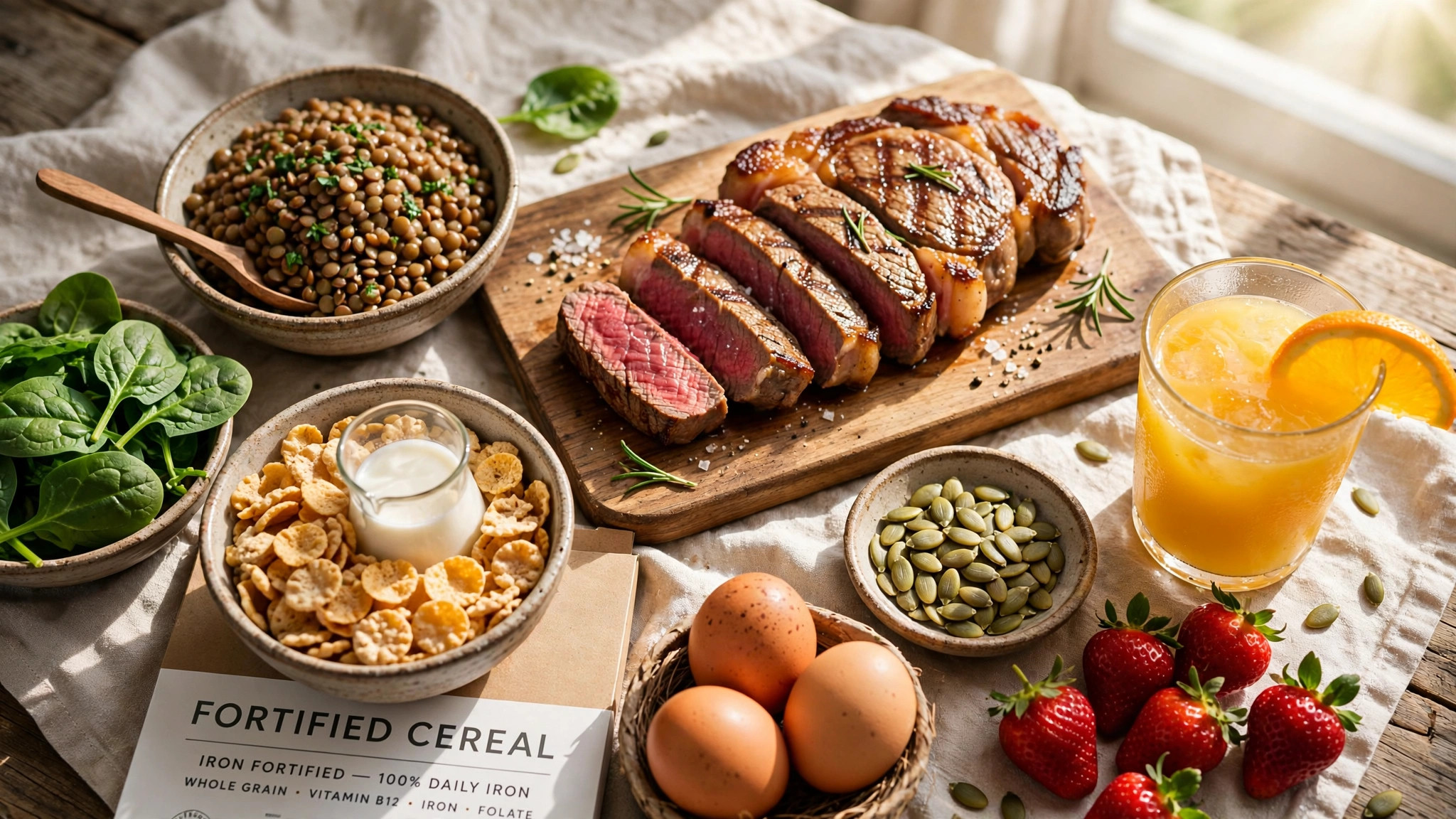
Getting enough iron from food is very doable once you know the sources and the absorption tricks.
Top heme-iron sources (easily absorbed, roughly 15-35% uptake):
- Lean beef — a 3-ounce serving packs about 2 to 3 mg
- Chicken thighs and turkey
- Canned tuna and salmon
- Clams and oysters (clams are off the charts — around 8 mg per 3 ounces)
- Pork tenderloin
Top non-heme sources (2-10% uptake, but adds up fast):
- Lentils — about 3 mg per half cup cooked
- White beans and chickpeas
- Tofu and tempeh
- Fortified cereals (many deliver 8 to 18 mg per serving — check the label)
- Pumpkin seeds — about 4 mg per ounce
- Spinach — about 3 mg per half cup cooked
- Quinoa, dark chocolate, and blackstrap molasses
The vitamin C trick. Vitamin C converts non-heme iron into a form your body absorbs far better — boosting uptake several-fold. Squeeze lemon over lentil soup, eat strawberries with your oatmeal, or add bell peppers to a bean burrito.
Avoid blockers at iron-rich meals. Coffee and tea contain tannins that can cut iron absorption dramatically — wait an hour or two after a meal for your cup. Calcium-rich foods and supplements also compete with iron, so take your calcium supplement at a different time of day.
Should You Supplement?
If a blood test shows you are deficient, food alone may not close the gap quickly — especially with heavy periods. Iron supplements are cheap, widely available, and effective. A few practical notes:
- Ferrous sulfate is the classic, inexpensive option; iron bisglycinate is a gentler alternative that causes less constipation and nausea.
- Take it on an empty stomach with vitamin C for maximum absorption — but if that causes nausea, take it with a small meal instead. Consistency beats perfection.
- Don't take it with coffee, tea, or calcium. Space them out by at least two hours.
- Recheck your levels. Ferritin (your iron storage marker) should be retested in 2 to 3 months. Many doctors target a ferritin above 50 ng/mL for resolving symptoms, even though lab "normal" ranges start lower.
- Keep iron pills away from children. Accidental iron overdose is one of the most dangerous childhood poisonings. Treat the bottle like medication — because it is.
And one more important caution: do not start high-dose iron on a hunch. Unexplained iron deficiency in men, or in women after menopause, can signal GI blood loss that needs a medical workup — not a supplement.
The Bottom Line
Exhaustion has a thousand possible causes, but iron deficiency is one of the few with a simple, cheap, reliable fix. If you are dragging through your days on enough sleep, especially if you have heavy periods, eat mostly plant-based, or donate blood regularly, ask your doctor for a ferritin and CBC test at your next visit. It is one blood draw — and for millions of tired Americans, it is the answer they have been looking for.
📚 Keep reading:
Acid Reflux: Why Heartburn Keeps Coming Back
About 1 in 5 American adults lives with GERD. That burning chest pain after meals is common — but it is not something you just have to live with.

Plantar Fasciitis: Fix Morning Heel Pain Fast
About 2 million Americans get plantar fasciitis every year. That stabbing first-step heel pain is fixable — usually without surgery. Here is what works.

Shingles Vaccine: Why Every American Over 50 Needs It
One in three Americans will get shingles. The Shingrix vaccine is over 90% effective at preventing it — yet millions of adults over 50 still have not gotten it.