Measles Is Back in America: What to Know Now
In the year 2000, the United States declared measles eliminated — gone, finished, a disease American parents no longer had to fear. Twenty-six years later, that victory is slipping away.
As of mid-October 2026, the CDC has confirmed 4,410 measles cases across the country — nearly double the 2,289 cases recorded in all of 2025, which was already the highest annual total in 33 years. The nation is on track for its worst measles year since 1991, and public health officials are warning that America's hard-won "elimination" status could be revoked as early as November, when a Pan American Health Organization commission meets to review it.
This is not a distant problem. Pennsylvania alone has reported more than 1,200 cases and five measles-associated deaths this year. New York's governor declared a statewide disaster emergency on October 5. And 96 percent of cases are in people who are unvaccinated or whose vaccination status is unknown.
Here is what is actually happening — and what you should do about it.
Why measles came roaring back
Measles is not a relic. It is one of the most contagious viruses known to medicine: a single infected person can infect 12 to 18 unvaccinated people, and the virus can hang in the air for up to two hours after the infected person leaves the room. You do not need to touch anyone. You just need to breathe the same air in a doctor's waiting room, a school, or a grocery store.
For decades, that ferocious contagiousness was held in check by one thing: near-universal childhood vaccination. Two doses of the MMR (measles, mumps, rubella) vaccine are 97 percent effective at preventing measles. But coverage has been sliding. MMR vaccination among U.S. kindergartners fell from 95.2 percent in the 2019–2020 school year to 92.4 percent in 2025–2026 — leaving roughly 280,000 kindergartners unprotected, according to the CDC.
Once community coverage dips below about 95 percent, measles finds the cracks and spreads. In 2026, the CDC has recorded 42 outbreaks — clusters of three or more linked cases — and about 95 percent of all U.S. infections are outbreak-linked. Children and teens aged 5 to 19 account for 42 percent of cases. But this is not just a children's disease anymore: adults 20 and older make up 41 percent of 2026 cases, and they are being hospitalized at a higher rate (14 percent) than the kids.
What measles actually does to the body
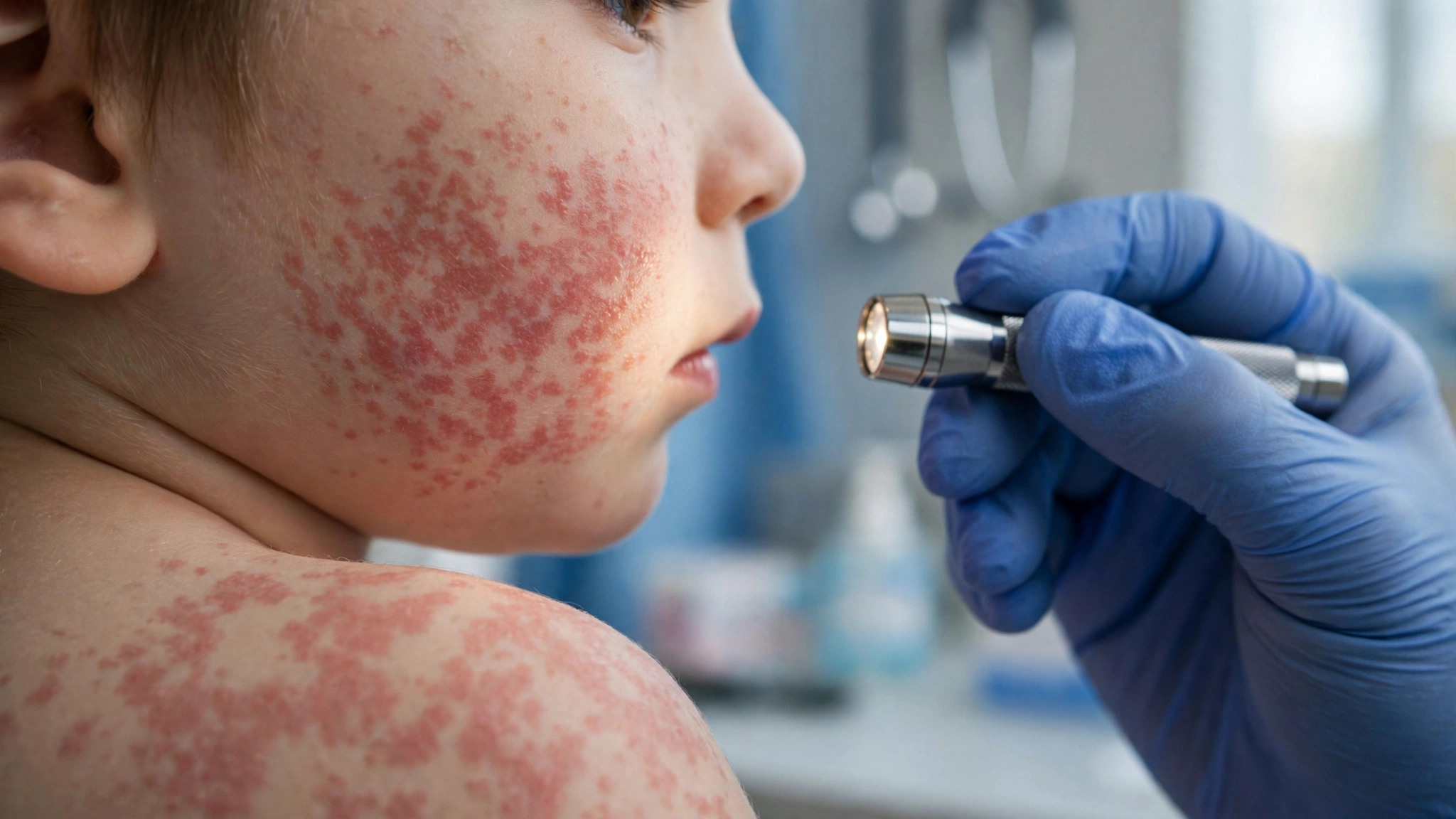
Measles starts out looking deceptively ordinary. Seven to 14 days after exposure, you get a high fever (often over 104°F), cough, runny nose, and red, watery eyes. Inside the cheeks, tiny white spots — called Koplik spots — may appear. Then comes the signature: a red, blotchy rash that starts at the hairline and face and spreads downward across the body.
For most healthy, vaccinated people, this would never happen. For the unprotected, the risks are real and sobering:
- Pneumonia — the most common cause of measles death in young children
- Encephalitis — brain swelling, striking about 1 in 1,000 cases, which can leave permanent brain damage
- Death — roughly 1 to 3 out of every 1,000 measles cases, almost always in unvaccinated people
- SSPE — a rare but almost always fatal brain disorder that can develop 7 to 10 years after infection, especially in children infected before age 2
- "Immune amnesia" — measles can wipe out the immune system's memory of past infections, leaving survivors vulnerable to other diseases for months or years
About 10 percent of U.S. cases this year — 451 people — have been hospitalized. Measles also hits pregnant women hard, raising the risk of premature birth and low birth weight. There is no specific antiviral drug for measles; treatment is supportive care, and the WHO recommends vitamin A doses for children with the disease to reduce severity.
The warning signs: when to act fast
Call your doctor before going in if you or your child develops:
- High fever plus the "three C's" — cough, coryza (runny nose), and conjunctivitis (red eyes)
- A rash that starts on the face and spreads downward 3 to 5 days after the fever
- Tiny white spots inside the cheeks (Koplik spots) — a near-certain early sign
- Difficulty breathing, confusion, severe headache, or seizures — get emergency care immediately
One critical rule: do not walk into a waiting room unannounced. Because measles spreads through the air, calling ahead lets the clinic isolate you instead of exposing every newborn, pregnant patient, and immunocompromised person in the building.
Seek care urgently for infants under 12 months, pregnant women, and anyone with a weakened immune system — these are the groups at highest risk of severe disease.
What actually protects you
The answer is simple, boring, and 97 percent effective: the MMR vaccine.
- Children: first dose at 12–15 months, second dose at 4–6 years. Kids traveling internationally can get an early dose at 6–11 months (it does not count toward the two-dose series).
- Adults born in 1957 or later with no evidence of immunity should get at least one dose; two doses are recommended for healthcare workers, college students, and international travelers.
- Born before 1957? You are generally considered immune from natural exposure. One exception: if you were vaccinated between 1963 and 1967, you may have received the less effective inactivated vaccine and should get at least one dose of the live MMR.
- Not sure of your status? There is no harm in getting another MMR dose — but a simple blood test (measles titer) can confirm immunity first.
Adults who missed vaccination are not just protecting themselves. With 280,000 kindergartners entering school unprotected, herd immunity is fraying — and babies too young for their first shot depend entirely on the vaccinated people around them.
The bottom line
America eliminated measles once, and it can hold that ground again — the tools have not changed. Two doses of MMR, given on schedule, end this story. The current surge is not a failure of the vaccine. It is a failure of coverage.
Check your family's records this week. If anyone's shots are missing or uncertain, a single call to your pediatrician or primary care doctor closes the gap. In a year when one cough in the wrong waiting room can sicken a dozen unvaccinated people, that phone call is the cheapest, simplest health insurance you can buy.
Sources: CDC Measles Cases and Outbreaks (data through October 15, 2026), Pennsylvania Department of Health, USA Today, Al Jazeera. This article is for informational purposes only and is not medical advice — talk to your doctor about your vaccination status.
Rao Sajid is the founder and editor of VitalDaily. He covers everyday health topics — nutrition, sleep, fitness and wellness — turning guidance from public-health sources like the CDC, NIH and FDA into plain, practical advice. More about Rao →
📚 Keep reading:
Why You Wake Up at 3 AM (And How to Fall Back Asleep)
Millions of Americans jolt awake around 3 AM and can't drift off again. The culprit is part biology, part habit — and most of it is fixable. Here's why it happens and how to get back to sleep.

Thanksgiving Food Safety: 7 Mistakes to Avoid
Thanksgiving sends thousands of Americans to urgent care every year. From thawing mistakes to the 2-hour rule, here are the 7 food-safety errors to avoid.

Winter Dry Skin: Why It Happens and How to Fix It
Tight, itchy, flaky skin every winter? Cold air and indoor heat strip moisture from your skin. Here is why it happens — and the dermatologist-backed fixes that actually work.