Wall Sits Beat Cardio for Lower Blood Pressure
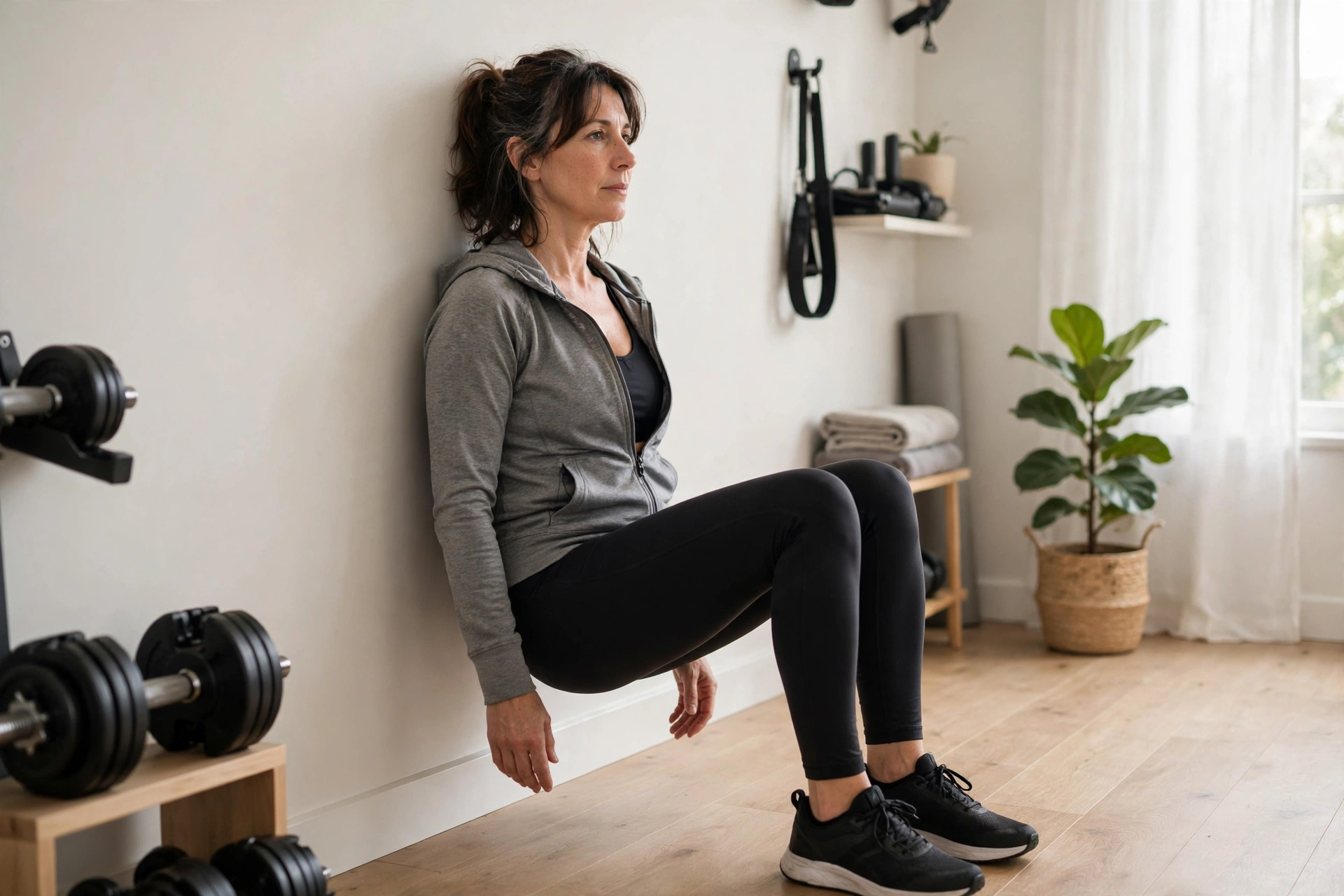
For decades, doctors have given the same exercise prescription for high blood pressure: walk, jog, get your heart rate up. It's good advice — but it turns out the single most effective exercise for lowering blood pressure requires no walking at all. In fact, it requires almost no movement.
You just slide your back down a wall and hold still.
A landmark 2023 analysis in the British Journal of Sports Medicine pooled 270 randomized controlled trials involving 15,827 people and compared every major exercise type head to head. Aerobic exercise lowered systolic blood pressure by about 4.5 points. Weight training, about the same. High-intensity interval training, roughly 4 points.
Isometric exercise — contracting muscles without moving them, as in wall sits and planks — lowered systolic pressure by an average of 8.24 points, and diastolic by 4 points. That's nearly double the effect of cardio. When researchers ranked the interventions for lowering the top number, isometric training came out first with 98.3% certainty — the clearest winner in the entire analysis.
Why 8 points is a big deal
To put that number in perspective: a widely cited Lancet analysis of 123 studies and more than 600,000 people found that every 10-point drop in systolic blood pressure is linked to roughly 20% fewer major cardiovascular events, 27% fewer strokes, and 28% less heart failure. An 8-point reduction from sitting against a wall — no gym, no equipment, no prescription — lands within striking distance of that benchmark.
And America needs it. Nearly half of U.S. adults — about 120 million people — have high blood pressure, according to CDC figures, and roughly 3 in 4 of them don't have it under control. In 2024, high blood pressure was a primary or contributing cause of over 680,000 deaths in the United States. It's called the silent killer because it causes no symptoms while quietly damaging arteries, the heart, the brain, and the kidneys.
Why holding still works on blood pressure
Isometrics create a unique stress on your vascular system. When you squeeze a muscle and hold it, the sustained contraction temporarily compresses the blood vessels inside the muscle, restricting local blood flow. When you release the hold, blood rushes back in — and researchers believe that repeated compression-and-release cycle trains your blood vessels to become more elastic over time.
The mechanism is vascular, not cosmetic: repeated isometric bouts appear to improve endothelial function — the ability of artery linings to widen and relax — partly by stimulating nitric oxide signaling, the same molecule your body uses to keep vessels supple. The baroreceptors that regulate blood pressure also appear to recalibrate with consistent practice.
One nuance worth knowing: isometrics dominated for systolic pressure (the top number), but aerobic exercise actually performed better for diastolic pressure (the bottom number). So this isn't an argument for abandoning your walks — it's an argument for adding wall sits to them.
The exact protocol the studies used
The trials that produced the 8-point drop generally used a simple prescription:
- 4 wall sits of 2 minutes each, with 2-minute rests between holds
- Performed 3 times per week
- Total time per session: about 14 minutes including rests
That's roughly 12 minutes of actual holding, three days a week — no treadmill, no commute to the gym.
How to do a wall sit correctly
Find a flat wall and plenty of floor space. Slide your back down until your thighs are parallel to the floor and your knees are bent at roughly 90 degrees — like sitting in an invisible chair. Keep your feet flat, hip-width apart, with your knees stacked directly over your ankles (never let them cave inward or drift past your toes). Press your entire back, shoulders, and head against the wall. Arms relaxed or crossed.
Then the hard part: breathe. This is where people get it wrong. Holding your breath while straining — the Valsalva maneuver — causes a sharp temporary spike in blood pressure, which is exactly what you're trying to avoid. Breathe slowly and steadily through the entire hold, in through the nose, out through the mouth.
If two minutes feels impossible
It probably will, at first. That's fine. The benefits scale with effort, and a half-depth hold still counts. Try these progressions:
- Week 1–2: Aim for 4 holds of 30–45 seconds at a higher, easier angle (back only partway down)
- Week 3–4: Work toward 4 holds of 60–90 seconds
- Week 5+: Build to the full 4 × 2-minute protocol at a 90-degree bend
Don't push through sharp knee pain. If wall sits bother your knees, switch to handgrip isometrics — squeezing a handgrip device or a tennis ball at about 30% of your max effort, 4 sets of 2 minutes per hand. Handgrip protocols were among the best-studied isometric interventions in the meta-analysis and showed similar pressure-lowering effects.
Add planks as a backup
Planks engage the core isometrically and were included in the broader isometric category. They're a solid secondary option, but in the sub-analyses, wall sits specifically outperformed other isometric forms — the large leg muscles engaged in a wall sit may drive a bigger vascular response. If you can only pick one, pick the wall sit.
Three safety rules before you start
- Talk to your doctor first if you have uncontrolled high blood pressure, heart disease, or a history of stroke. Isometric holds cause a temporary rise in blood pressure during the contraction itself; the benefit comes afterward. Most people with well-controlled hypertension can do them safely, but anyone with severe or unstable cardiovascular disease should get clearance first.
- Don't hold your breath. Ever. Keep air flowing throughout the hold. If you find yourself grunting and straining, you're going too deep or holding too long — back off.
- Don't drop your medication. The trials measured isometric exercise as an addition to — not a replacement for — prescribed treatment. Tell your doctor you're starting; if your numbers improve consistently, medication adjustments should only ever come from them.
The honest fine print
Isometrics aren't magic, and the researchers themselves were careful about this. Most trials were relatively short (at least 2 weeks, many a few months), so the very-long-term data is thinner than for aerobic exercise. Aerobic training still wins for diastolic pressure, heart failure prevention, weight control, mood, and sleep. And no exercise — isometric or otherwise — cancels out a diet drowning in sodium or 40 pounds of extra weight.
The realistic takeaway: if you have blood pressure you want to move downward, the highest-return exercise per minute of your time may be the one where you barely move at all. Three wall-sit sessions a week, on top of your regular walks, a diet that goes easy on salt, and your doctor's plan.
Your wall is already there. It costs nothing. The evidence says it works.
📚 Keep reading:

Why the Room Spins When You Roll Over in Bed
That sudden spinning when you turn over in bed is usually BPPV — tiny 'ear crystals' loose in the inner ear. Here is why it happens and the simple head maneuver that fixes it.

Norovirus: The Winter Stomach Bug Sanitizer Can't Kill
It causes up to 21 million U.S. illnesses a year, survives on surfaces for days, and laughs off hand sanitizer. Here's what actually stops norovirus.

Fatty Liver: The Silent Epidemic in 1 in 3 Americans
Roughly 1 in 3 American adults has fatty liver disease — most never feel a symptom. New tests, a first-ever drug, and a weight-loss target that can reverse it.