Can't Stand on One Leg for 10 Seconds? Read This
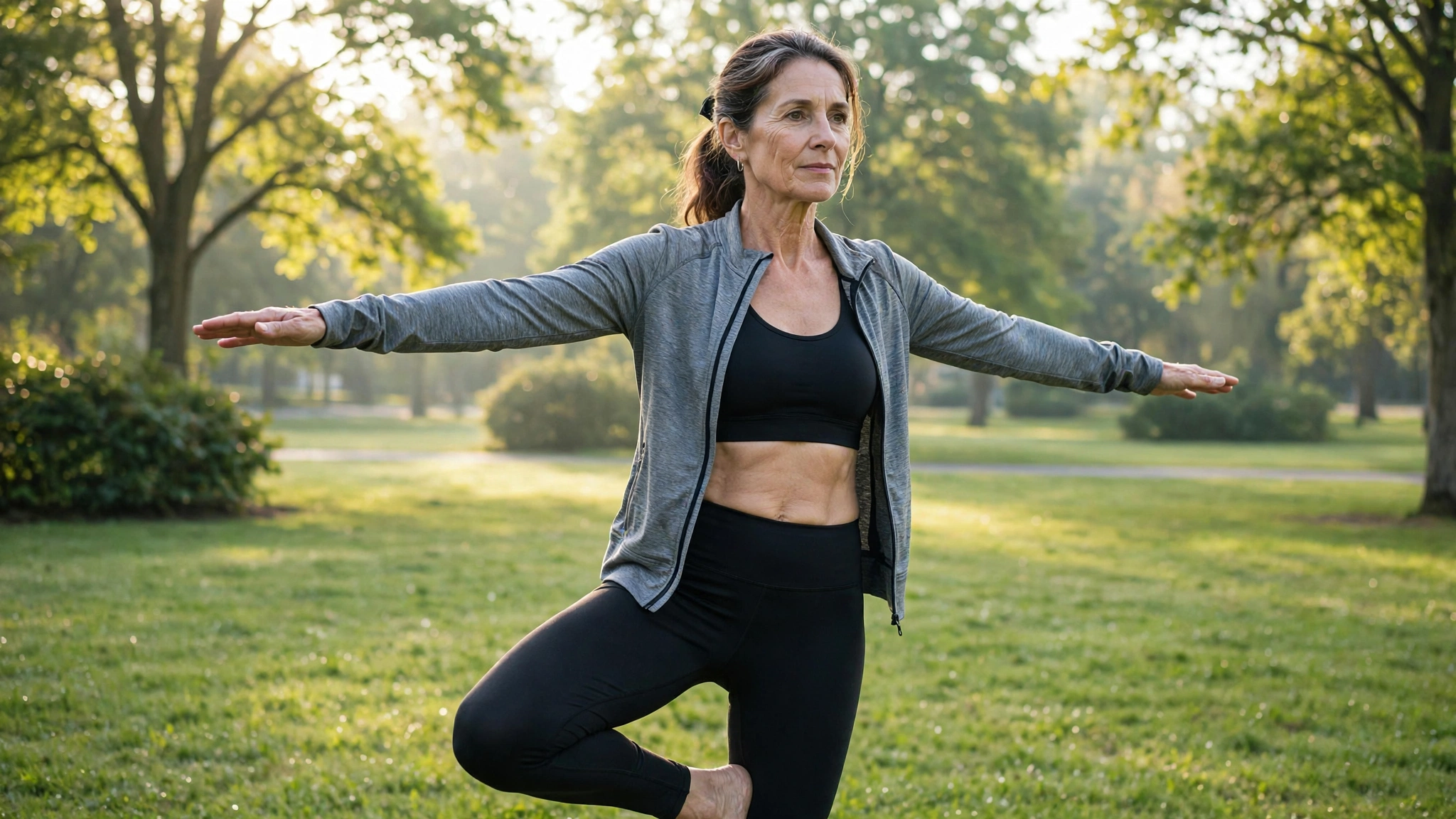
Here's a health test that takes ten seconds, requires no equipment, and may say more about your future than your last blood panel: stand on one leg, arms at your sides, and hold it for ten seconds.
If you can't, pay attention. A widely reported study published in the British Journal of Sports Medicine (2022) followed about 1,700 adults aged 51 to 75 and found that those who failed the 10-second one-legged stand faced an 84% higher risk of dying from any cause over the next several years — even after researchers adjusted for age, weight, and existing health conditions.
It wasn't a fluke. Balance is one of the most underrated vital signs in medicine. And unlike your cholesterol or blood pressure, you can improve it in minutes a day, in your living room, with zero equipment.
Why balance is a window into your health
Balance looks simple, but it's a full-body negotiation. To stay upright, your brain fuses signals from three systems: your inner ear (the vestibular system, which senses head movement), your eyes, and proprioception — the sensors in your muscles and joints that tell your brain where your limbs are without looking.
All three degrade with age. After 30, adults lose roughly 3 to 8 percent of their muscle mass per decade, and the rate accelerates after 60. Vision dims, reaction times slow, and medications can add dizziness to the mix. The result: balance quietly erodes long before anyone notices.
The consequences aren't abstract. According to the CDC:
- 1 in 4 Americans aged 65 and older falls each year — about 36 million falls annually
- 3 million older adults land in the emergency room for fall injuries every year
- Falls are the leading cause of injury and injury death in older Americans
- Fall injuries cost the U.S. health system roughly $50 billion a year
Most people discover their balance is gone the moment it matters most — on an icy step, a loose rug, or a dark staircase. Training it ahead of time is one of the cheapest longevity interventions that exists.
Test yourself: the 10-second balance check
Try this now (near a wall or sturdy chair, just in case):
- Stand barefoot on a flat surface, arms relaxed at your sides
- Lift one foot about six inches off the floor
- Hold for 10 seconds without wobbling, grabbing, or putting the foot down
- Repeat on the other side
In the 2022 study, about 1 in 5 participants couldn't complete it — and the failure rate climbed sharply with age. If you passed easily, great — you have a baseline worth maintaining. If you wobbled or grabbed the counter, that's not a verdict; it's a starting point. Balance responds to training faster than almost any other physical capacity.
A note of caution: if you feel dizzy, get vertigo, or are on medications that affect balance (certain blood pressure drugs, sedatives, or antidepressants can), talk to your doctor before pushing balance exercises. Dizziness deserves a medical check, not just more practice.
How to train balance: a simple progression
Balance training works like strength training — start easy, add difficulty gradually, and stay consistent. Ten minutes a day beats an hour once a week.
Level 1: Build the foundation (weeks 1–2)
Single-leg stands. Near a wall or chair, lift one foot and hold 10–30 seconds per side. When that feels easy, hover your fingertips just above the chair instead of gripping it, then let go entirely. Two to three rounds per side, once a day.
Heel-to-toe walking. Walk in a straight line placing the heel of one foot directly in front of the toes of the other, like a sobriety test. Arms out for balance. Go 15–20 steps, turn around, repeat. This one challenges your balance while moving — which is when most real falls happen.
Brush-your-teeth balance. Stand on one leg while brushing your teeth — two minutes, twice a day, built into a habit you already have. It's the easiest balance routine ever invented.
Level 2: Add instability (weeks 3–6)
Eyes-closed single-leg stand. Closing your eyes removes visual input and forces your inner ear and proprioception to do the work. Start with a hand on the wall — this gets hard fast. Even 5–10 seconds counts.
Tandem stance holds. Stand with one foot directly in front of the other, heel to toe, and hold 30 seconds. Then try it with eyes closed.
Slow marches and step-ups. March in place lifting knees to hip height, or step up and down on a single stair. Slow and controlled beats fast and sloppy.
Level 3: Make it dynamic (ongoing)
Tai chi. This is the gold standard of balance exercise. The slow, weight-shifting movements of tai chi are one of the few interventions the CDC specifically recognizes for fall prevention — some trials show it cut fall rates by up to 43% in older adults. Community classes run $10–20 a session in most U.S. cities, and free videos are everywhere on YouTube.
Strength training. Balance lives in your legs. Squats, lunges, deadlifts, and calf raises build the muscles that catch you when you stumble. Research consistently shows that combining strength work with balance drills beats either one alone.
Uneven ground. Walk on grass, sand, or a gravel trail instead of pavement. Your ankles and stabilizing muscles work overtime on unpredictable surfaces — exactly the training real life demands.
Yoga. Tree pose, warrior III, and half-moon pose are balance training disguised as stretching. A weekly class covers balance, strength, and flexibility in one hour.
The daily habit that costs nothing
You don't need a program, an app, or a gym. The people with the best balance simply practice it in the seams of ordinary life:
- Stand on one leg while the coffee brews or the microwave runs
- Take the stairs instead of the elevator — one step at a time, using the rail less each week
- Walk heel-to-toe down the hallway when nobody's watching
- Get up from a chair without using your hands (then try it from the floor)
Small, frequent doses win. The neuromuscular system learns balance through repetition, and five minutes scattered through the day works as well as a dedicated session.
The bottom line
Cardio gets the headlines and strength training gets the glory, but balance is the skill that keeps you independent. The 10-second one-leg test takes less time than reading this sentence — and if you failed it, today is the best day to start training.
Your future self — the one walking confidently down an icy sidewalk at 80 — will thank you.
📚 Keep reading:
Late-Night Snacking May Raise Liver Disease Risk 30%
A new study of nearly 200,000 U.S. adults links eating after dinner to a 20 to 30 percent higher risk of fatty liver disease and cirrhosis. Here's what it means.
Lower Cholesterol Naturally: 9 Proven Strategies That Work
Nearly 86 million American adults have high cholesterol. Here's what cardiologists say actually lowers it — no crash diets, no fads, just proven moves.
Zone 2 Cardio: The Longevity Exercise Americans Skip
Longevity doctors spend most of their cardio time exercising EASY, not hard. Here's the Zone 2 science, how to find your pace, and a simple weekly plan.