Sciatica: Why Your Leg Hurts and What Really Helps
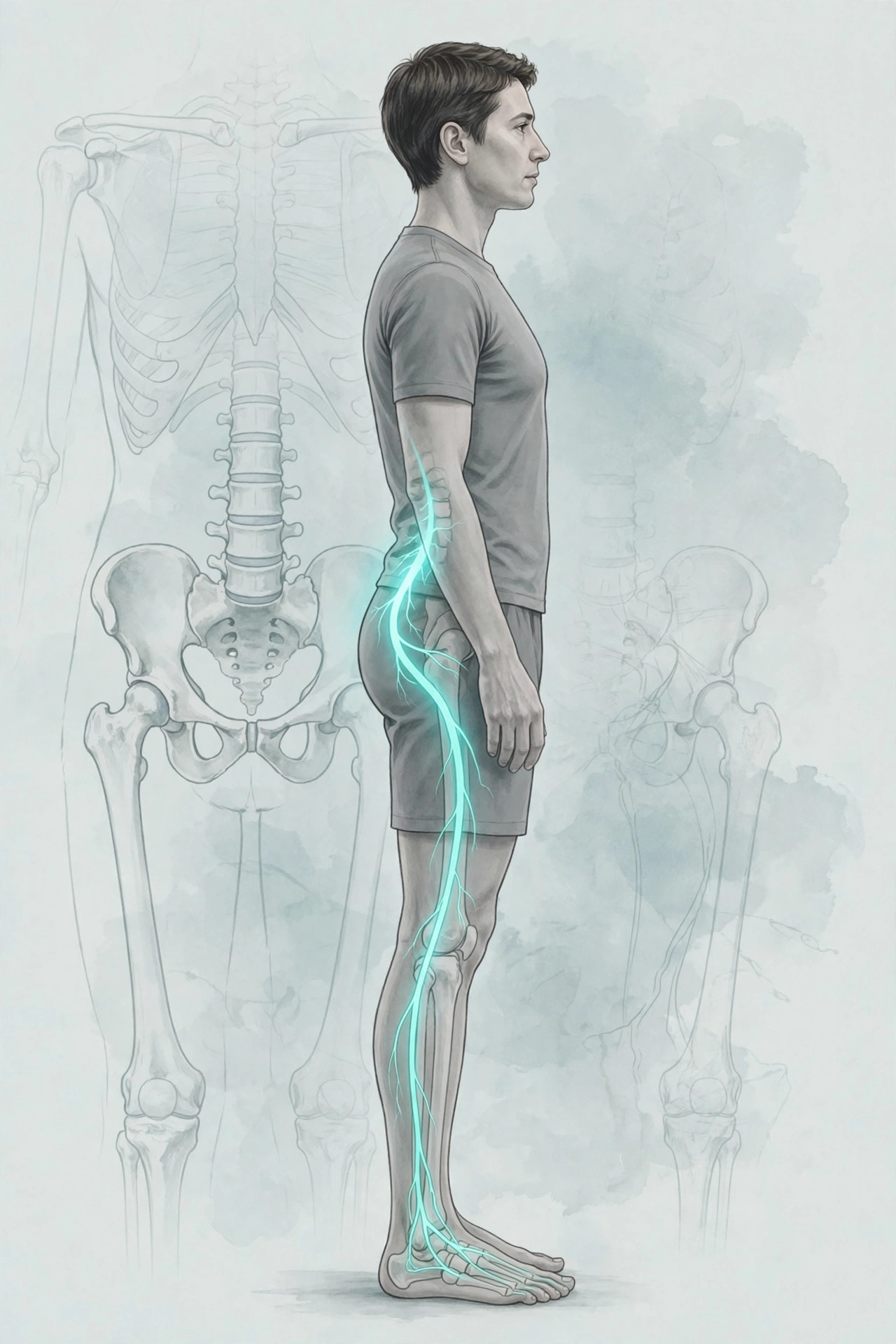
It starts as a strange ache deep in one buttock, then travels: down the back of the thigh, into the calf, sometimes all the way to the foot. Sitting makes it worse. Standing feels like a gamble.
Up to 40% of American adults will experience sciatica at some point in their lives, peaking in the 30s, 40s, and 50s — one of the most common reasons people call in sick with back pain.
The good news: most sciatica gets better without surgery, and the fixes that work best are simple and doable at home. Here is what is happening, what actually helps, and when leg pain means calling a doctor.
What sciatica actually is
Sciatica is not a diagnosis — it is a symptom of an irritated or compressed sciatic nerve, the largest nerve in the human body. Five nerve roots branch off your lower spine, join up in the pelvis, and run as one trunk through the buttock and down the back of each leg. When that highway gets pinched, pain follows the whole route.
That is why sciatica almost always strikes one side, and why the pain lives below the knee rather than just in the back. True sciatica is leg-dominant: the leg hurts more than the back does.
Why the nerve gets pinched
About 90% of sciatica cases trace back to a herniated or bulging lumbar disc. With age — often starting in your 30s — the discs between your vertebrae dry out and stiffen. One awkward lift or years of desk sitting can push disc material outward, where it presses on a nerve root.
Other causes are less common but real:
- Spinal stenosis: the canal the nerve travels through narrows with age, common after 60.
- Piriformis syndrome: a muscle deep in the buttock tightens and squeezes the nerve that runs beneath it.
- Spondylolisthesis: one vertebra slips forward over the one below it, pinching the nerve.
- Bone spurs from osteoarthritis can crowd the same space.
Risk factors stack up the way you'd expect: carrying extra weight, sitting most of the day, heavy lifting or lots of driving, smoking, and diabetes.
The symptoms worth knowing by name
Mild sciatica feels like a dull ache in the buttock and back of the thigh. The more intense version brings:
- Sharp, burning, or electric-shock pain running down one leg
- Tingling, numbness, or weakness — trouble standing on tiptoes, for example
- Pain that spikes when you cough, sneeze, or sit too long
- Relief when you stand, walk, or lie down with your knees bent
A note on mimicry: tight hamstrings and hip arthritis can imitate sciatica. The tell is the pattern — true nerve pain follows the nerve's path below the knee. Back pain with no leg symptoms is rarely sciatica at all.
The most important thing: keep moving
For decades, the standard advice for back and leg pain was bed rest. That advice was wrong. Modern guidelines from the American College of Physicians say the same thing: prolonged bed rest slows recovery.
You do not need to run a marathon — but staying gently active is the single most effective thing you can do:
- Walk. Short, frequent walks beat one long one — start with 10–15 minutes a few times a day.
- Avoid sitting marathons. Get up every 30–60 minutes.
- Heat and ice both help. Ice for the first 48 hours of a sharp flare, heat afterward — 15–20 minutes at a time.
About 80–90% of sciatica cases improve with conservative care alone, usually within 6–12 weeks. Surgery is a last resort — for people who have failed months of conservative treatment or have severe, progressive weakness.
What actually fixes it
1. Movement-based treatment, not just pills
Over-the-counter NSAIDs like ibuprofen or naproxen can take the edge off for a few days, and they work best combined with activity. But pills alone do not fix a pinched nerve — the fix is mechanical: reduce the pressure on the nerve and teach the spine to move better.
2. Physical therapy and targeted exercises
A physical therapist can usually identify in one visit whether your sciatica is disc-related or piriformis-related — each responds to different exercises. Two of the most effective:
- McKenzie press-ups: Lie face-down, press your chest up while keeping hips on the floor, hold a few seconds, repeat 10 times. If leg pain retreats toward the back, that is a good sign.
- Piriformis stretch: Lie on your back, cross the sore-side ankle over the opposite knee, and pull the bottom leg toward your chest until you feel a deep stretch in the buttock. Hold 30 seconds, repeat 3 times.
Ten minutes of the right exercises daily beats an occasional heroic stretching session.
3. Core and hip strength for the long game
Once the acute pain settles, prevention is about support. A weak core and tight hips force the lower spine to do work it shouldn't. Bridges, bird-dogs, and side planks build the scaffolding; hip-flexor stretches keep the pelvis moving freely. A lumbar roll in the car and a monitor at eye height remove the slow daily squeeze on the discs.
4. Sleep position matters more than people think
Sleeping on your back with a pillow under your knees, or on your side with a pillow between your knees, keeps the spine neutral. Stomach sleeping is the worst option for sciatica — it arches the lower back and loads the discs all night.
What does NOT help (despite the marketing)
- Long bed rest. Beyond a day or two, it weakens muscles and stiffens the spine.
- All-day back braces. They can help for short tasks, but constant use lets your own support muscles slack off.
- Aggressive self-cracking. A pop feels satisfying, but forceful twisting can aggravate a disc.
- Most sciatica supplements. No solid evidence magnesium, turmeric, or B-complex relieve nerve compression. Money better spent on a physical therapy visit.
Opioids deserve a special mention: the CDC recommends against them as a first-line treatment for sciatica. They dull pain without fixing anything and carry real addiction risk.
When to call a doctor — and when it is an emergency
Most sciatica is a weeks-long nuisance. But red flags mean stop waiting and get evaluated promptly:
- Loss of bowel or bladder control, or numbness in the "saddle" area (inner thighs, groin) — this can signal cauda equina syndrome, a rare surgical emergency. Do not wait; this needs ER care within hours.
- Rapidly worsening leg weakness or foot drop.
- Pain after a fall or car accident, fever alongside back or leg pain, or a history of cancer.
- Pain that has not improved at all after 6 weeks of self-care — time for imaging and a specialist.
The bottom line
Sciatica is frighteningly common, usually disc-related, and — despite how dramatic it feels — resolves without surgery in the vast majority of cases. The people who recover fastest keep walking, get a physical therapist involved early, and treat long sitting like the toxin it is for a cranky nerve.
The leg pain is your nerve's way of saying something is pressing where it shouldn't. Listen to it, move with it, and in most cases it will let go of you far sooner than you fear.
📚 Keep reading:

RSV Isn't Just a Kids' Virus: What Adults 50+ Must Know
RSV hospitalizes up to 160,000 older Americans yearly — yet most adults 50+ have never heard of it. Here is who needs the vaccine and how to stay safe this season.

Why Are My Feet Always Cold? 7 Causes and Fixes
Cold feet that never warm up are not just a winter annoyance — they can signal circulation problems, Raynaud's, thyroid issues, or anemia. Here is what the 7 most common causes are and what actually fixes them.

Holiday Weight Gain: The Real Numbers (Not 10 Lbs)
You probably won't gain 10 pounds this holiday season — but the 1 pound you do gain tends to stick around for years. Here is what the research really says, and 9 practical ways to beat it.