Dizzy When You Stand Up? Causes, Risks, and Fixes
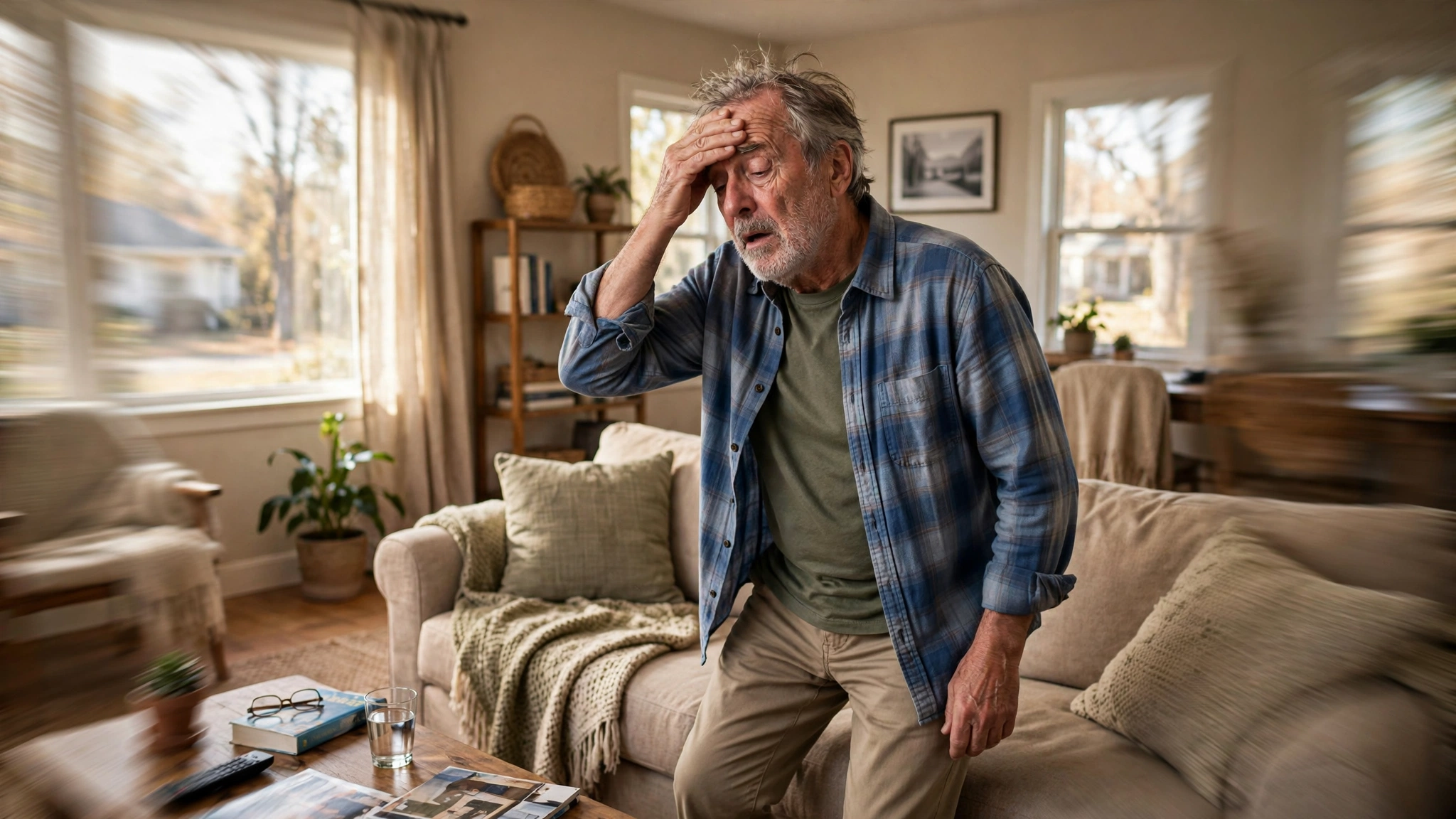
You are sitting on the couch after dinner, or lying in bed scrolling your phone. You stand up — and for a second or two, the room tilts. Your vision grays out at the edges and you grab the nearest wall until it passes.
Most Americans shrug it off as a head rush. But that dizzy spell has a medical name — orthostatic hypotension — and it is far more common than most people realize. Studies estimate it affects roughly 1 in 20 adults, climbing to as many as 1 in 3 people over 70. For older adults it is a leading contributor to falls, and the CDC reports that one in four Americans aged 65 and older falls each year, with falls the top cause of injury-related death in that age group.
The good news: most causes are fixable, and a few simple habits can make the episodes far less frequent.
What is actually happening in your body
When you stand, gravity pulls roughly a pint of blood into your legs, and your brain briefly gets less blood — and oxygen — than it expects.
Normally that dip lasts only seconds. Baroreceptors — pressure sensors in your neck and chest — detect it and order three quick fixes: your heart beats faster, your vessels constrict, and the dip corrects. Standing-up dizziness is what you feel in the brief window before the correction kicks in.
Orthostatic hypotension is diagnosed when systolic pressure drops at least 20 points (or diastolic at least 10) within three minutes of standing. The question is always the same: why isn't the correction happening fast enough?
The most common causes in American adults
Dehydration — the number one trigger
Even mild dehydration shrinks blood volume, leaving less margin when gravity pulls blood downward. It is especially common after a night's sleep (you lose water through breathing for eight hours), during heat waves, after workouts, or on days you simply forgot to drink. Older adults are most vulnerable — the thirst signal dulls with age, and many take diuretics ("water pills") that push fluid out.
Blood pressure medications
Ironically, the drugs that protect your heart can cause standing dizziness. Diuretics lower blood volume. Beta blockers blunt the heart-rate surge your body needs when you stand. Alpha blockers (often prescribed for prostate symptoms) and some calcium-channel blockers keep vessels too relaxed to constrict quickly. If your dizziness started within weeks of a new prescription or dose change, this is the prime suspect.
Aging and nerve conditions
After about 60, the baroreceptor reflex slows, vessels stiffen, and blood volume shrinks — that is why the same person who stood up briskly at 40 grabs the furniture at 70. Long-standing diabetes can also damage the autonomic nerves that run the pressure correction (autonomic neuropathy); Parkinson's and other neurological conditions do the same.
Big meals, alcohol, heat, and bed rest
A large carbohydrate-heavy meal diverts blood to digestion — postprandial hypotension, common in older adults. Alcohol dilates vessels and dehydrates. Heat does both: vessels dilate to cool you while sweat drains volume. A hot shower on an empty stomach after a beer is practically a recipe for a dizzy spell. And prolonged bed rest — a week of flu, a hospital stay, or months of sedentary living — weakens the whole cardiovascular response, the same reason astronauts struggle to stand after returning to Earth.
When a dizzy spell is dangerous
Most episodes are benign. But dizziness when standing can occasionally be the first sign of something serious. Seek medical care promptly if you notice any of these:
- You faint or nearly faint repeatedly — a full loss of consciousness is never "just a head rush"
- Dizziness comes with chest pain, shortness of breath, or an irregular or racing heartbeat — possible cardiac problems
- You have slurred speech, weakness on one side, vision loss, or confusion — treat these as stroke symptoms and call 911
- The dizziness is sudden, severe, or brand-new, especially with no medication change
- You have fatigue, pale skin, or breathlessness with activity — anemia is a fixable cause worth checking
For older adults, the danger is also what follows: a fall on a hard bathroom tile at 2 AM can mean a hip fracture or head injury. Frequent episodes deserve a fall-prevention conversation with your doctor.
Fixes that actually work
Stand up in stages — and pump your calves first
This is the single most effective habit. Before you rise, do 10 to 15 ankle pumps (flexing your feet up and down) to push pooled blood upward — your calf muscles act as a second heart. Then get out of bed by sitting on the edge for 30 to 60 seconds before standing; from a chair, pause, plant both feet, and rise steadily. Crossing your legs and tensing your lower body before standing (called "applied tension") can stop the gray-out entirely.
Hydrate deliberately
Aim for steady fluid intake — roughly eight 8-ounce glasses a day is the classic benchmark, more if you are active, older, or in heat. On high-risk days, an electrolyte drink helps more than plain water because sodium helps your body retain fluid. Drink a full glass before trigger situations: getting out of bed, a hot shower, a long flight.
Talk to your doctor about salt — carefully
For orthostatic hypotension with no heart failure or uncontrolled hypertension, doctors sometimes recommend a modest salt increase, since sodium expands blood volume. This is not DIY advice — extra salt can be dangerous with heart failure, kidney disease, or high blood pressure. Ask your doctor first.
Review your medications
Never stop a prescription on your own — but bring a complete list to your next appointment, noting when your spells happen. Doctors can often shift a blood-pressure dose to the evening or switch a diuretic so the peak drug effect does not coincide with your most vulnerable moments, like the morning stand-up.
Try compression
Knee-high or waist-high compression stockings (15–30 mmHg) reduce blood pooling in the legs and are surprisingly effective — one of the best non-drug tools for frequent episodes.
Eat smaller, and go easy on alcohol
If dizziness hits after meals, switch to smaller, more frequent meals and cut back on big carb loads. Limit alcohol, especially in the evening, and be cautious with saunas, hot tubs, and overheated rooms.
How doctors evaluate it
Expect blood pressure and heart rate measured lying down, sitting, and standing, a medication review, and blood work checking for anemia, dehydration, and blood sugar. If fainting is involved, you may get an ECG to rule out rhythm problems.
Treatment follows the cause: fix the medication, the dehydration, the anemia, or the underlying condition. For stubborn cases, the FDA-approved drugs midodrine and fludrocortisone raise standing blood pressure — but most people never need them.
The bottom line
That gray-out when you stand is your cardiovascular system losing a brief tug-of-war with gravity. Dehydration, medications, aging, and heat are the usual culprits — and standing up in stages, pumping your calves, hydrating well, and reviewing your prescriptions resolve most cases.
Mention it at your next checkup, but do not panic: for most people, a head rush is a fixable plumbing problem, not a broken system.
This article is for general information only and is not medical advice. If you experience fainting, chest pain, or other concerning symptoms, see your doctor promptly.
📚 Keep reading:
Prediabetes: 1 in 3 American Adults Has It — Most Don't Know
96 million American adults have prediabetes and 8 in 10 don't know it. The good news: it's reversible with proven lifestyle changes. Here's the test to ask for and the plan that works.
Flight Blood Clots: Why Your Next Trip Could Be Risky
Over 300 million people take flights longer than 4 hours yearly. Sitting still that long can let a dangerous blood clot form. Here's who is at risk — and how to prevent it.

Frozen Shoulder: Why It Locks Up and How to Thaw It
Frozen shoulder locks the joint in three painful stages — freezing, frozen, thawing — and hits 1 in 5 people with diabetes. Here's why it happens, how long it lasts, and the treatments that actually restore movement.