Is Cracking Your Knuckles Actually Bad for You?
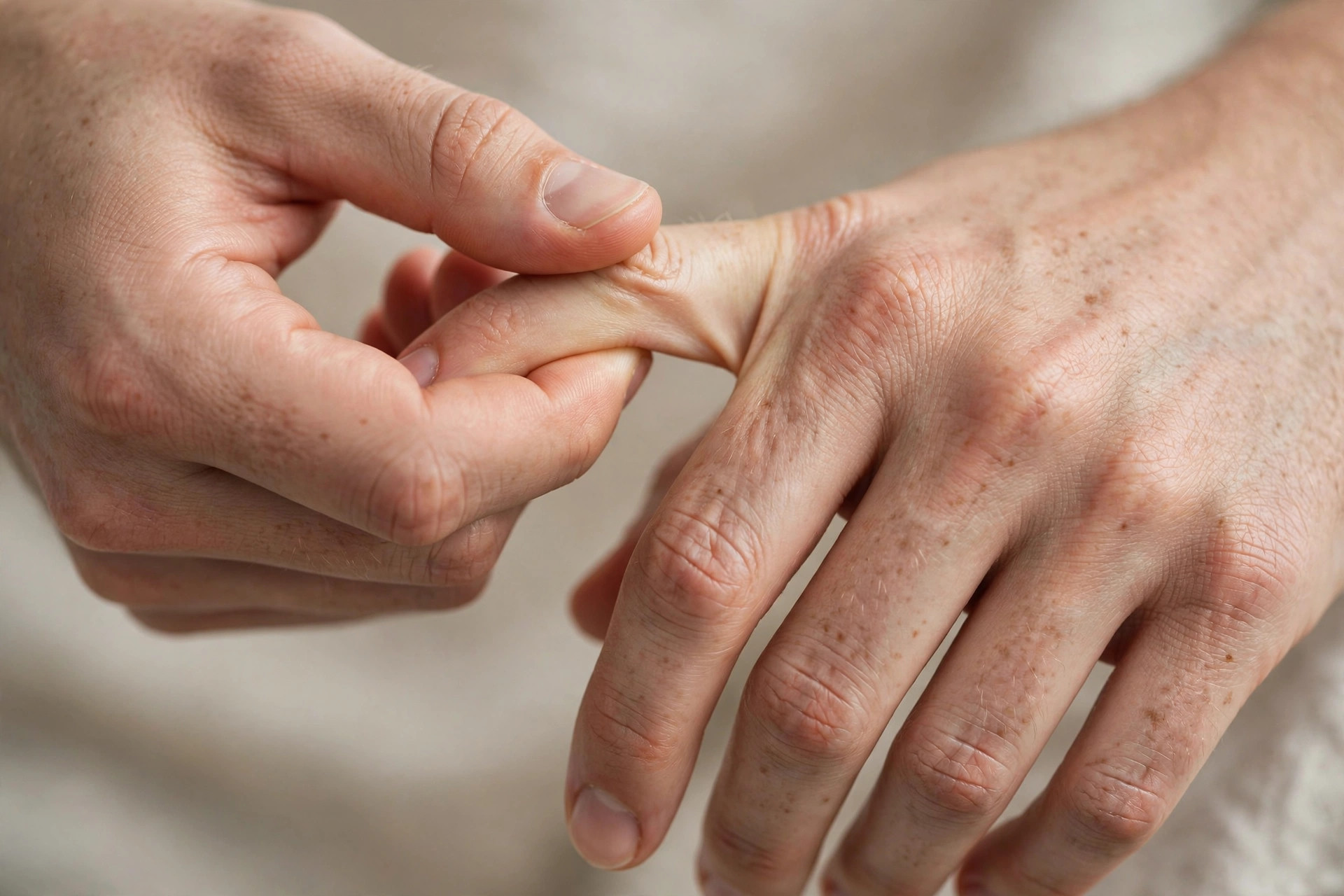
Every American kid has heard it: "Stop cracking your knuckles — you'll get arthritis!" For generations, that warning came with the full weight of parental authority. And yet an estimated one in two adults keeps doing it anyway — popping knuckles on conference calls, in traffic, and at the dinner table, much to everyone's annoyance.
So who was right? For once, the kids. Decades of research have put the arthritis question to rest. But the full story is a little more interesting — and a little less innocent — than a simple "it's fine."
What actually makes the pop
Your knuckle is a synovial joint: two bones meet inside a capsule filled with synovial fluid, a thick liquid that lubricates the joint. Dissolved in that fluid are gases — mostly nitrogen, carbon dioxide, and oxygen.
When you stretch or bend the joint far enough, the space inside the capsule suddenly expands. The pressure inside drops, and those dissolved gases come out of solution — forming a bubble, or cavity, almost instantly. That rapid formation is what produces the sharp "pop."
This isn't just theory. In a 2015 study published in PLOS ONE, researchers used real-time MRI to watch a finger joint crack as it happened. The images showed exactly what physicists predicted: the pop coincides with the sudden formation of a gas-filled cavity in the fluid — not the collapse of one, as scientists had believed for 70 years.
Once you've popped a joint, you can't pop it again right away. The gases need about 20 minutes to dissolve back into the fluid — which is why repeat cracking has to wait.
The doctor who cracked one hand for 50 years
The most famous piece of evidence in this debate came from a personal experiment that would make any scientist nod in respect.
Dr. Donald Unger, a California allergist, cracked the knuckles of his left hand at least twice a day for more than 50 years — and never cracked his right hand. In 1998 he published the results in Arthritis & Rheumatism: after half a century, neither hand showed arthritis, and there was no difference between the two.
His work earned him the Ig Nobel Prize in Medicine in 2009 — and a vindication for every knuckle-cracker in America.
Larger studies backed him up. In 2011, researchers in the Journal of the American Board of Family Medicine studied 215 adults and found no statistically significant link between habitual knuckle cracking and hand osteoarthritis. A 2017 imaging study likewise found that habitual crackers had the same amount of joint cartilage wear as non-crackers.
The American College of Rheumatology's position lines up with the evidence: cracking your knuckles does not cause arthritis.
The part nobody tells you: it's not 100% innocent
Here's where the story gets its nuance. "Doesn't cause arthritis" is not the same as "completely harmless."
Researchers who studied habitual crackers noticed two things worth mentioning. First, the 2011 JABFM study found that habitual knuckle crackers were more likely to have hand swelling and measurably lower grip strength than people who didn't crack — even though their joints showed no arthritis. Scientists aren't sure whether aggressive cracking causes the weakness or whether people with looser joints are simply more likely to crack.
Second, aggressive cracking can injure soft tissue. Medical journals carry case reports of people who hurt themselves with enthusiastic cracking — including ligament sprains, torn tissue around the joint, and even a dislocated finger. There's a difference between a gentle pop and yanking your finger sideways with full force.
Bottom line: gentle knuckle cracking is harmless. Violent, forceful cracking is a needless risk.
When cracking joints ARE a warning sign
There's one important distinction. The satisfying pop of a voluntarily cracked knuckle is not the same as joints that crack, grind, or catch on their own — especially when it comes with other symptoms.
See your doctor if joint sounds come with:
- Pain in or around the joint when it pops
- Swelling that doesn't go away within a day
- Stiffness, especially morning stiffness lasting more than 30 minutes
- Locking or catching, where the joint briefly gets stuck
- Grinding (crepitus) that gets worse over time, particularly in knees or hips
- Reduced range of motion or a joint that feels unstable
Unwanted popping with pain can signal osteoarthritis, a meniscus or ligament issue, or inflammation like tendonitis — all worth a proper evaluation. But a painless knuckle pop you do on purpose? That's in a different category.
How to quit if it bugs you (or everyone around you)
Cracking is mostly a habit — and like any habit, it responds to replacement, not willpower. Try these:
- Catch the trigger. Notice when you do it: stress, boredom, idle hands on a call? Habits thrive on autopilot; awareness is step one.
- Give your hands something to do. A stress ball, a fidget ring, or a pen to twirl occupies the same "idle hand" impulse.
- Stretch instead of pop. Gently spread your fingers wide for 5 seconds, make a fist, and repeat 5 times. It relieves the stiffness that makes you want to crack.
- Wait out the urge. The impulse usually peaks and fades within a minute. Having to wait 20 minutes to re-pop a joint is actually on your side.
- Set a tally goal. Count cracks per day for a week, then try to beat your record each week. Gamifying it works better than cold turkey.
A 2-minute hand routine for stiff fingers
If you crack because your hands feel stiff — common after long hours at a keyboard — these do what cracking only pretends to do:
- Finger fans: Spread all fingers as wide as possible, hold 5 seconds, relax. Repeat 5 times.
- Fist squeezes: Make a tight fist, hold 3 seconds, then open fully. Repeat 10 times. Squeeze a soft ball for more resistance.
- Thumb touches: Touch each fingertip to your thumb, going pinky to index and back. Slow and deliberate, 3 rounds.
- Wrist circles: Extend your arm, rotate the wrist 10 times clockwise, 10 counterclockwise.
- Prayer stretch: Press palms together in front of your chest, fingers up, and gently lower your hands toward your waist until you feel the stretch. Hold 15 seconds.
Stronger, more flexible hands get less of that restless "need to pop" feeling in the first place.
The verdict
Your parents were wrong about the arthritis. Half a century of one-handed knuckle cracking, plus multiple peer-reviewed studies, proved it. But gentle is the key word — crack casually if you like, don't yank, and pay attention if a joint starts popping painfully on its own.
The only real damage knuckle cracking does is to other people's nerves.
VitalDaily articles are for informational purposes only and are not a substitute for professional medical advice. If you have joint pain, swelling, or limited mobility, see a healthcare provider.
Rao Sajid is the founder and editor of VitalDaily. He covers everyday health topics — nutrition, sleep, fitness and wellness — turning guidance from public-health sources like the CDC, NIH and FDA into plain, practical advice. More about Rao →
📚 Keep reading:

Do You Really Need a Multivitamin? What Science Says
Roughly one in three Americans swallows a multivitamin every day, spending billions a year. But what do the biggest clinical trials actually show? The answer is more nuanced than the ads.

Donating Blood: The Health Perks You Didn't Expect
One blood donation can save up to three lives — and it quietly hands you a free health check, lower iron buildup, and a calmer heart. Here's what the research says.
Tonsil Stones: The Hidden Cause of Stubborn Bad Breath
You brush, floss, and gargle — yet your breath still smells. Tiny white pebbles hiding in your tonsils could be why. Here's what they are and how to get rid of them.